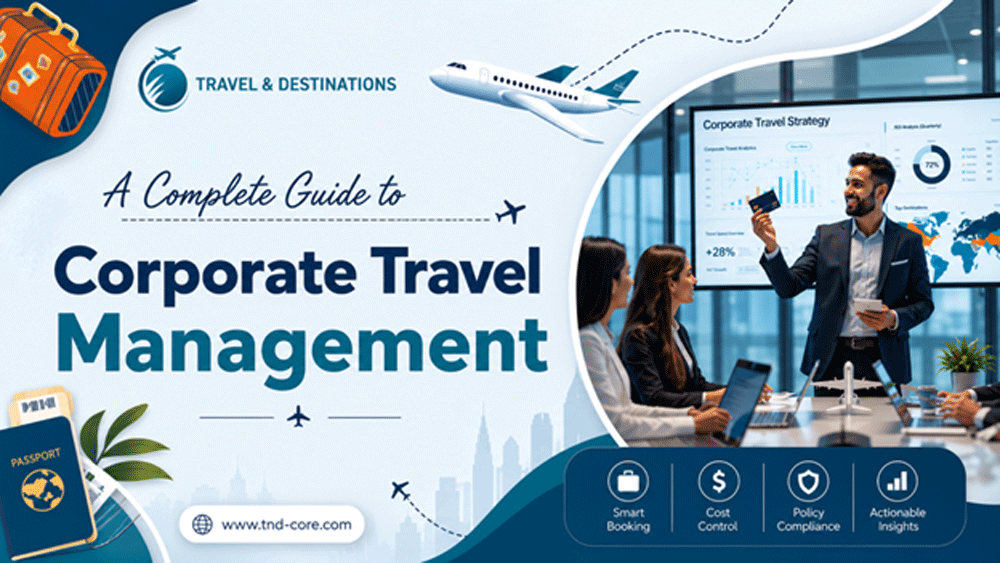
A Complete Guide to Corporate Travel Management
Fifty trips a month, three departments, a dozen approval chains. Getting one employee to a client meeting is easy. Scaling that across an entire company is where things get messy, and that's the gap corporate travel management exists to close.
What is the Foundation of Corporate Travel Management?
Control without friction, mostly. A business travel management company builds the policies and vendor relationships that let employees book a trip without every single request landing on someone's desk for sign-off. Cost has to stay visible. Traveler safety can't slip either. Balancing both isn't as easy as it sounds on paper, and most companies figure that out the hard way after a few messy trips.
What Does Corporate Travel Management Involve?
More departments than most people would guess. Within the organization, we can find:
- Travel Managers, who set policy and negotiate with vendors directly
- Finance, tracking spends and reconciling every expense report that comes in
- Risk Management — handles traveler safety and what happens if a trip goes sideways
- Human Resources, since travel benefits touch employee wellbeing more than most realize
- Technology teams running the booking platforms behind the scenes
- Externally, airlines, hotels, ground transport providers, and often a corporate trip planner or agency partner like us, TND (Travel and Destinations), managing the day-to-day logistics
What Are the Common Tasks in Corporate Travel Management?
Nobody puts this list in a strategy deck, but it's where most of the actual work happens.
- Pricing. Negotiated rates, fare monitoring, catching the cheaper option before it disappears
- Itinerary planning built around meetings, not the other way round
- Transportation — flights, trains, whatever gets someone from the airport to the office
- Accommodation booked within policy limits
- Meetings, including venue and attendee coordination
- Policy compliance, flagging anything booked outside approved limits
- Travel support that's actually available at 2 a.m. when a flight gets cancelled
How Can You Automate Corporate Travel Management in Your Organization?
Manual approval chains are usually the first casualty. Automated tools apply policy rules right at the point of booking, not three days later in an email thread. That alone cuts out hours of back-and-forth a travel manager used to spend chasing approvals. Business travel management services built around this kind of automation tend to pay for themselves within a year, mostly through reduced admin time rather than any dramatic cost cut on flights.
Top 5 Advantages of Automating Corporate Travel Management
- Booking turnaround gets faster.
- Policy violations get caught before they happen instead of after.
- Spend visibility becomes real-time instead of a month-end surprise.
- Travel teams spend less time on admin.
- Better data comes out of it too, which helps when negotiating vendor rates the following year.
How AI Is Shaping New Trends in Corporate Travel Management
Prediction is the shift worth watching. Tools are starting to flag flight delay risk before check-in even happens, or suggest a rebooking option the moment a connection looks shaky. Corporate business travel management services are also using this for personalized itinerary suggestions, built around what a traveler has actually booked before rather than a generic template. It's early days, but the move from reactive to predictive is already showing up in how bookings get handled day to day.
Conclusion
Corporate travel management stopped being just logistics a while back. It's policy, technology, and risk management working together, and for most companies that means leaning on a business travel management company for the parts an internal team simply doesn't have time for. We at TND (Travel and Destinations) have built our process around exactly that gap.
FAQs
Recent Posts











Leave a Reply
Your email address will not be published. Required fields are marked
Comments