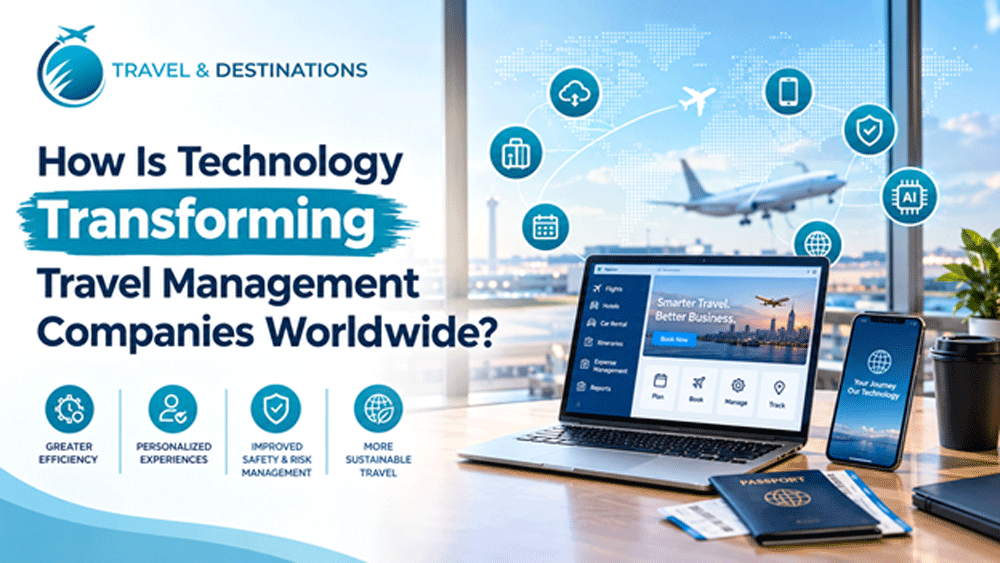
How Is Technology Transforming Travel Management Companies Worldwide?
Corporate travel used to run on spreadsheets, phone calls, and "travel agent near me" searches that ended with whoever picked up first booking flights. Not that long ago either. The shift has been faster than most industries anticipated, and travel management companies that haven’t moved with it are visibly struggling to retain business clients who now expect the same digital fluency from their travel partners that they get from every other business tool they use.
TND — Travel and Destinations — sits at the intersection of that shift, combining IATA-certified travel agency expertise with technology-driven solutions built for how businesses actually travel today.
What Is the Role of Technology in Modern Travel Management Companies?
A finance executive at a Gurugram company spent most of last March matching airline invoices against a trip spreadsheet nobody had touched since January, and nine trips weren't on it. Two others had been booked twice. That was the entire travel program: a shared inbox, some WhatsApp screenshots, one patient accountant.
Software now handles most of what a travel management company used to do by phone, from the first fare search to the report finance reads a month later.
Traditional vs. Technology-Driven Travel Management
The old model ran on people and inboxes. Someone emailed a request, an agent rang three airlines, a quote came back by evening. Fine for one traveler. It starts to fall apart around the fortieth booking of the month. A technology-driven setup puts fares and policy rules on the same screen, with approvals routed automatically, so the traveler sees what's allowed before choosing a seat. A good local travel agent still knows things no platform does, like which hotel entrance is shut for repairs, so the software should back that person up rather than replace them.
Why Businesses Need Digital Travel Management Solutions?
Paper trails don't scale. Past a certain headcount nobody can say who's flying where next week, and that's a duty-of-care problem as much as a cost one. Digital tools fix the visibility first. Direct airline content through IATA's NDC standard is the other piece: an IATA-certified travel agency can pull fares and extras that older booking systems don't always show. TND (Travel and Destinations) runs its corporate desk on that idea, and we'd rather show a client the screen than describe it.
How Is Artificial Intelligence Transforming Corporate Travel Management?
Most of the AI in travel booking is quiet. Nobody notices it until a fare they were about to buy disappears.
AI-Powered Travel Planning and Personalized Recommendations
A traveler who always takes the 7 am flight and an aisle seat shouldn't have to say so every trip. Tools pick that up and rank options with it, while the company's fare caps stay in front. There's a limit, obviously: it can only recommend what the policy allows.
Predictive Analytics for Corporate Travel Decisions
Fares move on patterns. A business travel agency with a few years of booking data can spot, say, that Bengaluru fares jump the week before quarter end, and nudge a team to book earlier. It's forecasting, nothing mystical. The catch is that the data has to be clean first, and plenty of programs start from a mess.
AI Chatbots and Virtual Travel Assistants
Trips unravel after office hours more often than before them. That's the case for a chatbot: it answers at 2 am. People still type travel agent near me into a search bar when something breaks, hoping a human picks up. The sensible setup is a bot that sorts the simple rebooking and hands the messy ones to a person, and TND keeps someone on the line behind its assistant for that handoff. Honestly, most travelers just want a person.
The Role of Generative AI in Business Travel Management
Generative AI is the newest piece and the one people oversell. It's good at drafting an itinerary from a messy email thread, or boiling a 40-page travel policy down to the paragraph a new joiner needs. It's poor with anything live, a fare especially, since it can state a price with total confidence and be wrong. We treat it as a drafting aid and keep a person checking the output.
How Digital Travel Solutions Support Sustainable Corporate Travel?
Business travel sits in Scope 3 of a company's emissions reporting, and more clients now ask suppliers for actual numbers.
Carbon Emissions Tracking for Business Travel
Each booking can carry an emissions estimate, usually worked out from distance and aircraft type, with the ICAO carbon calculator a common reference. Add them up by department and a pattern shows. One team's weekly Delhi to Bengaluru run might turn out to be a third of the total. Estimates stay estimates, but numbers beat guesses.
Sustainable Travel Options and Responsible Booking
Putting the train next to the flight, with emissions and door-to-door time shown, changes behavior more than a policy memo does. On a route like Delhi to Jaipur, plenty of travelers pick rail once somebody puts it on screen. Hotels with a recognized eco-certification can be flagged the same way, if the company wants to filter on it.
Balancing Cost, Convenience, and Sustainability
Nobody wins on all three every time. The cheapest fare leaves at 5 am, the greener train adds two hours. Good tools put that trade-off in front of the traveler and let the company set the rule, say rail for anything under four hours and flights beyond. We'd rather a rule exist than leave it to whoever's booking at 9 pm.
Key Benefits of Technology for Travel Management Companies and Businesses
Reduced Travel Costs and Administrative Work
Fewer emails, fewer manual invoice matches. A hotel invoice issued without the company's GSTIN can cost finance the input credit, and catching that at booking is cheaper than fixing it at quarter close. Fare savings come too, mostly from earlier purchases and better rate access, though the admin hours are where most teams feel it first.
Improved Booking Efficiency and Productivity
A booking that used to take a day of back and forth takes minutes once the approval is built in. Travelers stop waiting on replies. Managers stop being asked for them.
Greater Visibility Into Travel Spending
One dashboard, every trip. TND's reporting breaks spend down by department and route, so a finance head sees in a minute what used to take a week of chasing. A business travel agency that can't show that is working with half the picture.
Better Policy Compliance and Traveler Satisfaction
Compliance rises when the compliant option is the easy one. Travelers rarely break policy to be difficult; the approved fare was just buried three screens deep. Put it first and most of the argument disappears. Satisfaction follows, oddly, since people don't like being told no after the fact.
How to Choose a Technology-Driven Travel Management Company?
Ask for a live demo on your own sample trip, not the polished one in the brochure. Any travel management company that hesitates is telling you something.
Check the accreditation next. An IATA-certified travel agency settles through IATA's Billing and Settlement Plan and has airline-level access, so a rebooking doesn't depend on someone's goodwill. Ask for the IATA number and look it up. It takes a minute.
Plenty of companies find their first agency by typing travel agent near me into a search bar. Nothing wrong with starting there, but a local travel agent being ten minutes away says little about tools. Ask what booking platform they use. Then ask who answers the phone after office hours.
TND (Travel and Destinations) is IATA-accredited and runs corporate bookings through a platform with policy rules built in. People are on hand when the platform isn't enough.
Conclusion
Good people still run travel. Technology clears the busywork out of their way, and the test for any setup is whether finance saves time and travelers keep moving when plans fall apart. If you'd like to see how that looks on your own routes, talk to TND (Travel and Destinations) about a demo.
FAQs
Recent Posts

















Leave a Reply
Your email address will not be published. Required fields are marked
Comments